
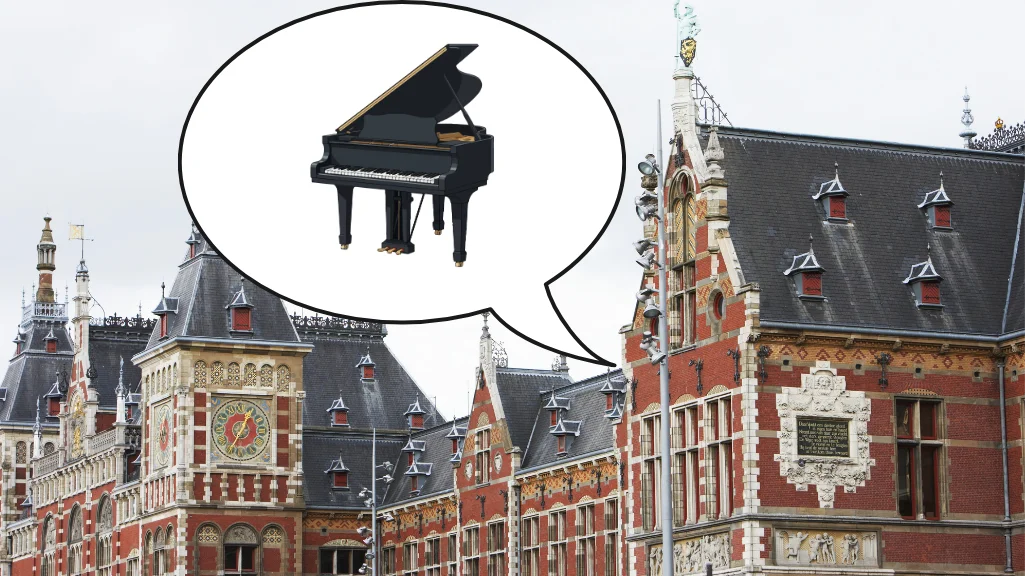
A different kind of arrival
Amsterdam is a city that seems to announce itself through movement.
Bicycles pass along the streets. Trams glide through the city. Boats cross the canals, and travellers arrive at Amsterdam Centraal with bags, maps and plans for the day.
But somewhere inside the station, another rhythm can be heard.
The sound of a piano.
Perhaps someone is playing a piece they have practised for years. Perhaps a traveller is improvising while waiting for a connection.
Either way, something unusual happens.
People who were rushing towards their next destination begin to slow down.
How the Netherlands embraced station pianos
The story of the Dutch railway piano began in September 2014.
According to the national railway operator, NS, the first station pianos were installed in cooperation with partner organizations to create a more pleasant atmosphere in stations undergoing lengthy renovation work.
The idea proved more enduring than its original purpose.
What began as a way to improve the atmosphere of construction-affected stations evolved into a popular feature of railway travel.
NS now describes station pianos as places where travellers not only perform but also meet one another. Some people who first met at a station piano have continued playing music together.
It is a beautiful example of how a modest intervention can change the experience of a public space.
Where to find the piano at Amsterdam Centraal
Amsterdam Centraal is one of the stations currently listed by NS as having a public piano.
The railway operator identifies its location as the concourse on the city-centre side of the station.
This is useful for visitors arriving in Amsterdam by train: the piano is associated with the main station rather than a distant music venue.
Before travelling specifically to play, check the latest NS information. A listed piano may occasionally be unavailable because of station operations or maintenance.
More than one public piano in Amsterdam
Amsterdam Centraal is not the only station in the city with a public piano.
NS also lists instruments at several other Amsterdam stations:
Amsterdam Sloterdijk — concourse beside Starbucks.
Amsterdam Amstel — station concourse.
Amsterdam Bijlmer ArenA — station concourse.
Amsterdam Zuid — southern side of the Brittenpassage.
These are locations documented by the railway operator, rather than unverified community reports.
For visitors who enjoy discovering public pianos, this creates the possibility of exploring Amsterdam through its railway network.
A musical itinerary through Amsterdam
Begin at Amsterdam Centraal, where the station's historic architecture and its busy concourse make a memorable introduction to the city.
If the public piano is available, spend a few minutes listening or playing before heading outside.
From there, Amsterdam's canals, streets and cultural attractions provide plenty of opportunities for exploration.
Travellers who want to discover another station piano could include Amsterdam Amstel or Amsterdam Zuid in a longer itinerary.
The goal is not to visit as many pianos as possible.
It is to discover how music can become part of an ordinary journey.
The art of playing for strangers
There is something different about playing a piano in a railway station.
Unlike a concert hall, the audience has not necessarily come to hear music.
People may be waiting for a train, meeting a friend or simply passing through.
A performance can last only a few minutes, yet still become the most memorable part of someone's day.
For the pianist, the experience requires a particular kind of confidence.
You are playing for people who may not be listening at first.
But perhaps they will.
Where to stay near Amsterdam Centraal
For travellers arriving by train, accommodation near Amsterdam Centraal offers a convenient starting point.
The historic city centre is within reach, and the station provides connections to other parts of Amsterdam and the Netherlands.
Staying nearby can make it easier to include the station piano in your visit without planning a separate excursion.
Find accommodation near Amsterdam Centraal and discover a different side of the city, where music becomes part of the journey.
The next performance is always a surprise
A railway station is designed around schedules.
Trains arrive at specific times. Platforms change. Departure boards tell travellers where to go.
But the music of a public piano follows no timetable.
You never know who will sit down next.
You never know what they will play.
And you never know which stranger might stop to listen.
In a city famous for its canals, art and architecture, one of the most memorable experiences might be waiting inside the railway station.
All it takes is someone willing to play.